Banned Book Club: The Great Gatsby

Title: The Great Gatsby

Published: 1925

Author: F. Scott Fitzgerald

Challenge status:  #1 on  Radcliffe Publishing Course Top 100 Novels of the 20th Century and frequent target of banning attempts according to the ALA’s Office for Intellectual Freedom. Book #7 on Summer of Banned Books ’13.

Why: Challenged at the Baptist College in Charleston, SC (1987) because of “language and sexual references in the book.”

First line: “In my younger and more vulnerable years my father gave me some advice that I’ve been turning over in my mind ever since”.

Synopsis: As far as challenges go, this book seems pretty tame – but since it’s #1 on the Radcliffe list AND apparently a frequent target of banning attempts, I figured I should finally read it. I somehow successfully avoided it through high-school. It is, naturally, well written and provides an interesting view a fairly romantic set of characters.  Of course the truth of romantic characters – today as in the roaring 20’s – is that they are all full-on “Monets”. Meaning, from afar you can see only beauty – but up close, what you see is a big ol’ hot mess. The book is also a vague coming of age journey for the protagonist Nick Carraway, who is mainly a passive observer through the story. Nick provides a “reasonable man” lens through which we can see the dramatic concluding events – though he couldn’t provide a moral compass to his fellow characters.

And of course the themes and messages are timeless. That fantasies, once built up in one’s mind, made even more elaborate over the years are curiously difficult to obtain in the flesh and will often disappoint. That some people will spend their lives driven by a fear-of-missing-out, and will end up missing out on all the things that matter. That money can’t buy you love – or if it can, someone else can probably outbid you for it. That fans are not friends and will disappear as your popularity fades. That people take what they have for granted until threatened by its absence, or find out what they have is desired by a rival. That some people have a sense of entitlement so deep that they literally don’t see people who cross their paths as anything more than stepping stones. That wealth and power are seductive, but can brutally isolating. That one’s character may be one’s destiny, but it’s what you do (behavior, not beliefs) that defines your legacy.

This book is a perpetual classic; always au courant in the portrayal of an elite social class that glitters but is ultimately hollow. I wonder if that’s the more subversive piece of the book; the language and references to adultery seem pretty PG compared to the graphic evisceration of the American dream.


Banned Book Club: Happy Bloomsday & some notes

Photo Jun 16, 8 26 34 AM

Round 1! And we’re just getting started.


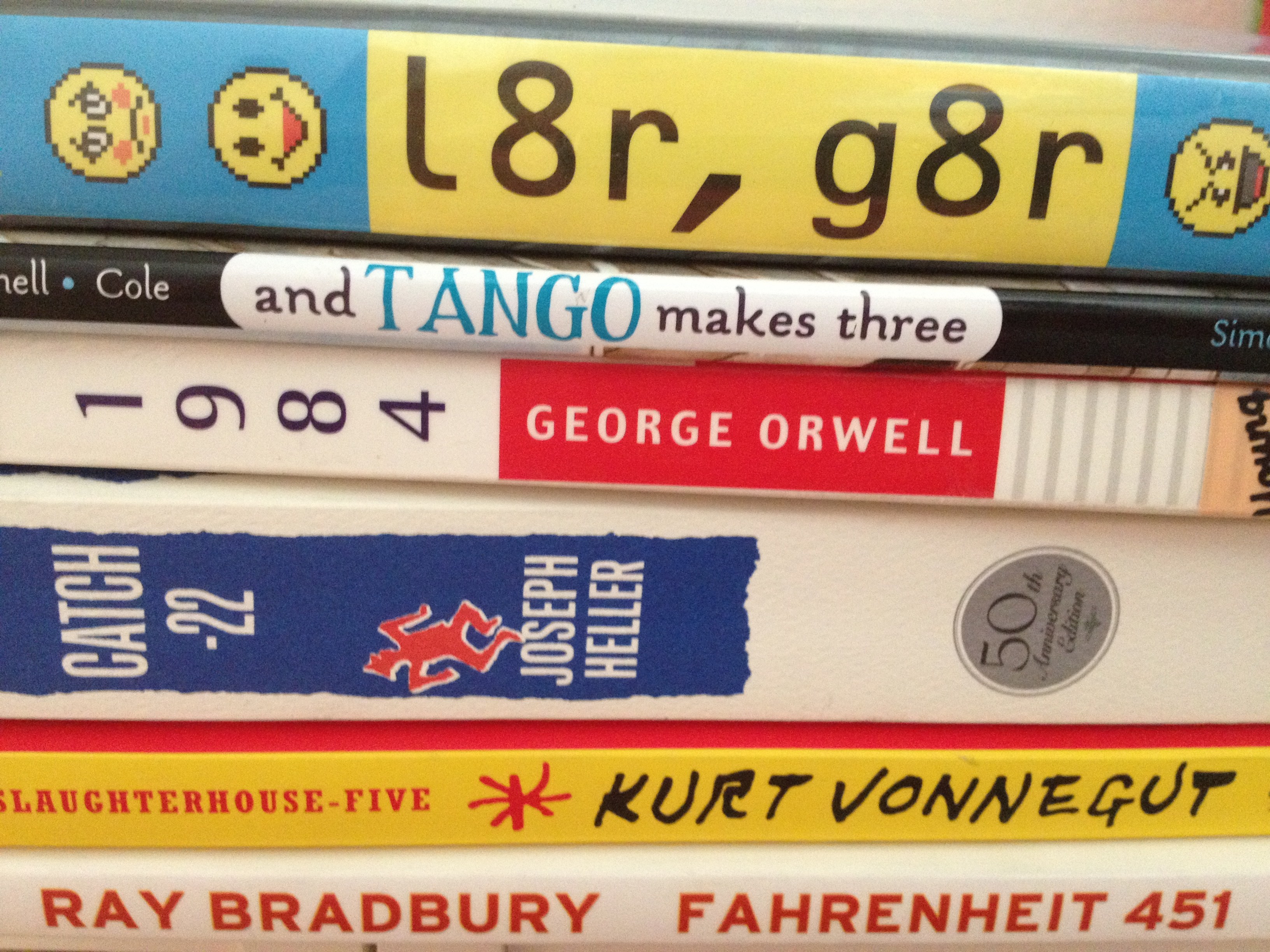
For those of you following along thus far, you know I’m getting prepped for Banned Books Week 9/22-28. I’ve finished the first sprint (frequently challenged books with titles containing numbers!) and am taking a quick breath before diving into the next set of books. So far I’ve read & updated on:

I kind of like this mixing of classics with the newer books, though I feel more enriched drilling-down into great books than into what’s controversial today. (e.g. no, i will not be reading Twilight or 50 shades of grey). So I have the next grouping of books to announce, but first want to say Happy Bloomsday! And Happy Father’s Day!

And so today, in honor of Bloomsday (which commemorates the life of James Joyce and his novel Ulysses), I’m going to read: 1) The decision from US vs Ulysses/Random House (in which U.S. District Court Judge John Woolsey) lifts the ban on Ulysses, and 2) “Penelope”; the last episode of the novel, from the perspective of Molly Bloom.

Most of the books on my list have been challenged or banned from public libraries/schools. But Ulysses is a little different – it was actually prosecuted under obscenity laws in many countries; though written in English, resistance to the material was fierce enough that the book was first published in its entirety in Paris (1922) – and literally banned in the US & UK (there are records of the USPS burning copies) through the 20’s. In 1933 the ban was effectively lifted in the US when  Judge Woolsey ruled that the book was not pornographic and therefore could not be obscene.

James Joyce’s novel Ulysses was published in 1922, and follows the day of main character Leopold Bloom on June 16, 1904. (Joyce’s first date with his then-future wife Nora was on 6/16, and he set the date for his novel accordingly. ) The text, one of the most important works in Modernism, is extremely dense: rich in language, historical references, mythological allusions – and puns. To the reader the book is a chaotic blend of dreams criss-crossed with reality, but the tidal stream-of-consciousness prose does, somehow, reveal meaning. In 1998, the Modern Library ranked Ulysses first on its list of the 100 best English-language novels of the 20th century. I read Ulysses myself for the first time during a summer in college, when I was living in Philadelphia – home of the Rosenbach Museum (a book museum!) and one of the many places that celebrates Bloomsday annually.

After this excerpt from Ulysses, I’m going after these frequently challenged books next:

  • The Great Gatsby
  • The Satanic Verses
  • The Adventures of Captain Underpants
  • A Farewell to Arms
  • Native Son
  • To Kill A Mockingbird
  • The Jungle

Those of you who are very clever and know me well *might* think I’m procrastinating on something. Yes. I still need to upload my “Games We Play” notes, but actually I am procrastinating equally hard against my homework, also of the game theory variety.

Banned Book Club: l8r, g8r

Title: l8r, g8r (from the “ttyl” series)

Published: 2007

Author: Lauren Myracle

Challenge status: Books in this series were #1 most challenged books in 2011 and 2009, #3 in 2008, and #7 in 2007.

Why: Offensive language, religious viewpoint, drugs, nudity, sexually explicit, unsuited to age group.

First line: “zoegirl: maddie!!! i’m so excited, i can’t sit still! i can’t *believe* i’m gonna c doug in 2 hrs!”

Synopsis: I did not like this book.

No, it was no more banal than the Young Adult book-a-month series I read growing-up, and – while it’s true that high-school seniors swear, drink, do drugs, have sex, and engage in stupid shenanigans, I just don’t think this book really went anywhere. And while I know the upcoming generations communicate with each other probably primarily via IM and text messages, there was something a bit artificial and forced – cutesy gone too far – about the rhythm and pacing of the language. Almost 300 pages of it. Was it offensive? Yeah, in a kind of American Pie v6.0 with some additional drug references and swearing, written for 13 year old girls kind of way.

If you want to read something that is going to Freak You Out and also use teenage language like a weapon, check out Jack Womack’s Random Acts of Senseless Violence. If you want something a little more edgy than The Complete Anne of Green Gables for your 12 year old niece, maybe try the The Hunger Games.

Banned Book Club: And Tango Makes Three

Title: And Tango Makes Three

Published: 2005

Author: Justin Richardson and Peter Parnell (illustrated by Henry Cole)

Challenge status: Last year (2012) it was the #5 most challenged book tracked by ALA/OIF. #1 most challenged book in 2010, 2008, 2007 & 2006 (#2 in 2009).

Why: Homosexuality, religious viewpoint, and unsuited to age group.

First line: “In the middle of New York City there is a great big park called Central Park.”

Synopsis: I literally don’t know how to write this review. The book for young children, ages 4+ (pre-school to grade 3). It is based on a true story about two penguins who acted as “surrogates” to an unhatched egg (one penguin couple had two eggs, but could only care for one through the hatching process). The key point is that the two penguins acting as surrogates were both male – a and a couple – so the baby penguin (Tango) gets hatched by two daddies. It’s adorable, and it’s about love (the only direct commentary is when the zookeeper thinks to himself that Roy and Silo “must be in love”, but otherwise the book is simply about a loving family unit)

It’s easy to imagine the arguments that a same-sex (albeit penguin) couple successfully hatching and raising a baby has generated – on both sides. So let’s skip it. Main takeaway: Adorable and awesome penguins are adorable and awesome. It’s people that are crazy.


Banned Book Club: 1984

Title: 1984

Published: 1949

Author: George Orwell (i.e. Eric Arthur Blair) (1903-1950)

Challenge status: #9 on  Radcliffe Publishing Course Top 100 Novels of the 20th Century and frequent target of banning attempts according to the ALA’s Office for Intellectual Freedom. Book #4 on Summer of Banned Books ’13.

Why: Well, when challenged in Florida in 1981 the reasons given were that the book was “pro-communist and contained explicit sexual matter.”

First line: “It was a bright cold day in April, and the clocks were striking thirteen.”

Synopsis: The foreboding classic view of a future that is now partially here: a totalitarian regime that effectively controls not only the behavior but the very thoughts and memories of it’s citizens. Winston Smith is not a loyal member of the party: he has questions and doubts that end up pulling him into a theoretical resistance movement and into the arms of a fellow disbeliever (his lover Julia), both from which he is eventually saved via an active re-education that takes place deep in his heart and within the Ministry of Love (Miniluv).

Thanks to Orwell we now have some amazing vocabulary (thoughtcrime, Big Brother, newspeak, doublethink, unpersons) and concepts (entertainment screens that broadcast while conducting surveillance, mini-helicopters and microphones hidden in plain sight – always collecting data, office workers who’s whole function is to “correct” the news to reflect the current truth, party practices destabilizing bonds between family members as a method of distributing policy enforcement, a government that creates tabloids, lotteries, and pornography to keep the proletariat subdued, armies that bomb their own citizens to further the image that the country is at war, politicians that expend all surplus resources as part of useless skirmishes to keep the populace hungry and angry – never really seeking to change balances-of-power between the primary competing nation-states).

Continue reading

Banned Book Club: Catch-22

Title: Catch-22

Published: 1955

Author: Joseph Heller (1923-1999)

Challenge status: #15 on  Radcliffe Publishing Course Top 100 Novels of the 20th Century and target of banning attempts according to the ALA’s Office for Intellectual Freedom. Book #3 on Summer of Banned Books ’13.

Why: Language, References to women as “whores”. I’m guessing the sex, violence, and portrayal of religious leaders didn’t help either, but don’t see specific references to them.

First line: “It was love at first sight.”

Synopsis: Well. This book is hilarious, engaging, there’s a good storyline, and it’s very well written. Heller’s style of prose is delivered with the clever cadences and the comedic timing of steven wright (if steven wright did slapstick and deadpan at the same time). Technically this is satire. But what is actually saddest about the book is that, as we are wound tighter and tighter into the grip of the story, it stops feeling like satire and starts feeling like reality. Just a reality we wish we could lock into a box and make it disappear. The insanity in the beginning of the book is quite reasonable compared to what passes for sane, everyday behavior by the end of the book.

Yossarian, our main character, is a bombardier who wants out of combat missions. As he pursues his goal (35 completed missions), the goal posts keep getting moved ever further out (40 missions, no 45, no 50….) and the war keeps stretching on with no end in sight. Around him people crack, die, disappear or flourish based on how their nature dictates within the context of this camp outside Italy. No virtue goes unpunished and every vice ends up hyper-extending and warping each character into a cartoon. From Major Major’s desperation to be accepted “he had a shy and hopeful manner in each new contact, and he was always disappointed. Because he needed a friend so desperately, he never found one,”  to Colonel Cathcart’s desperate ambition “he could measure his own progress only in relationships to others,” and Milo’s Kafka-esque cross-country capitalist chess games (eggs, tomatoes, lobster, egyptian cotton, airplanes, combat mission details…) “They all belong to the syndicate…and they know that’s what’s good for the syndicate is good for the country…Everybody has a share.

Yossarian wants out, and here’s where the concept of Catch-22 comes in (first in conversation with Doc Daneeka): anyone who’s crazy enough to keep flying combat missions must be crazy, and thus can be grounded — all they have to do is ask! But the catch (Catch-22) is, that anyone who asks, i.e. wants to get out of combat duty, can’t actually be crazy. And thus can’t be grounded.

Interestingly, the term Catch-22 is actually a reference to the book; the term didn’t exist before the book was published. Originally the book was going to be called Catch-18 and went through a few variants before the author and editors just decided Catch-22 sounded the funniest.

Very good book, though the last few chapters started stressing me out – a kind of sympathetic reaction. I’ve been in a number of discussions lately about professional burnout (seems to be an epidemic in the tech/infosec industry) and so reading this story about a set of folks so stuck on a hamster wheel as their psychological states deteriorated at an accelerated rate was kind of startling: Stress. Pain. Anxiety…”Everybody has a share.”

Banned Book Club: Slaughterhouse-Five

Title: Slaughterhouse-Five

Published: 1969

Author: Kurt Vonnegut (1922 – 2007)

Challenge status: #46 on Top 100 Banned/Challenged Books: 2000-2009

Why: References to religious matters, sexual scenes, violence, obscene language, depictions of torture, ethnic slurs, negative portrayals of women, and references to ‘Magic Fingers’ (e.g. the vibrating beds). Note: There are records of this book being burned as well as challenged.

First line: “All this happened, more or less.”

Synopsis: Vonnegut is usually a trip to read, he comes up with all kinds of story-lines or plot devices that are just this side of absurd. Slaughterhouse-Five is his most autobiographical – think what you will about the incorporation of Tralfamadorians (the time traveling aliens that kidnap the main character). Ostensibly about the bombing of Dresden (1945, in WW II), the storyline follows Billy Pilgrim through his life – but not in a sequential timeline – rather, as Billy has gotten unstuck in time we bounce around his life story with him. The reader is ricocheted from the war, to an alien zoo, to formative events in Billy’s childhood, to major events and crises in Billy’s sunset years. At times one can almost see how the events connect, patterns manifest, and a coherent journey for our hapless protagonist. At others the reader feels as helpless as the unstuck-in-time Billy Pilgrim, forced to face the grimness of a wartime experience, the fading of memories and relationships, and the inevitability of life’s decline.

I’m not clear on whether, as a war veteran and thus witness of how little of our lives are really within our control, Vonnegut is genuinely making an argument against free will. But it is still an interesting reminder that as much as things change (people die! war ends!), eventually everything we experience in the moment immediately after becomes history. Just moments and figments trapped in amber.


Banned Book Club: Fahrenheit 451

Title: Fahrenheit 451

Published: 1951

Author: Ray Bradbury (1920 – 2012)

Challenge status: #69 on Top 100 Banned/Challenged Books: 2000-2009

Why: Language, “Questionable Themes”

First line: “It was a pleasure to burn.”

Synopsis: A dark look at the near future where firemen don’t put out fires, they start them — specifically in services of burning books, which are forbidden. An apt kick-off to my hot hot hot summer of banned books, Bradbury’s classic paints the pictures of a society where intellectuals have been driven into hiding, and the majority of Americans sedate themselves with a steady stream of meaningless data and entertainment. The resulting dullness of experience is reminiscent of the dystopia of 1984 and Brave New World. Montag, our main character, finds himself starting to slip sideways as small questions nag at him: Why does his wife cling so strongly to the vivid but absurd phono-color walls as comfort only to “accidentally” overdose on sleeping pills? What is in those books that their owners would choose death over giving up their libraries? Why is the country constantly at war? And – ultimately – why isn’t he happy?

Besides being a passionate love letter to the concept of intellectual thought and freedom, this is also a timely read in the era of Twitter, FB, Google Glass, Siri, & Bluetooth headsets. That which entertains us doesn’t necessarily nourish us.

Summer of Banned Books

BBW_Forbidden_200x200Every year or so, I realize there are way too many great books out there that I’ve never gotten around to reading. And then I get an itch to soak up the written word. Summer is coming, and while these season is usually a time for “beach” books, this summer I’d like to get prepped for Banned Books Week – this year it’s September 22−28.

The lists of banned books are distressingly long, every year the American Library Association’s Office for Intellectual Freedom compiles a list of the top ten books that are most frequently challenged in libraries and schools around the country. They also have lists on Frequently Challenged Books of the 21st Century100 Most Frequently Challenged Books by Decade – and my favorite – Banned/Challenged Classics. As it turns out, attempts have been made to ban nearly half (at least 46) of the Radcliffe Publishing Course Top 100 Novels of the 20th Century.

As a quant and occasional applied numerologist, somehow these made it onto my list of books to read first:

  • Fahrenheit 451
  • Slaughterhouse 5
  • Catch 22
  • 1984
  • And Tango Makes 3
  • l8r, g8r

It is pretty interesting to see how many books written for children or young adults (teenagers) are on the list of top banned books by year. I guess in some areas they already got the classics out of the way. 🙁