Banned Book Club: All The King’s Men

Title: All the King’s Men

Published: 1946

Author: Robert Penn Warren (1905-1989), named USA’s first poet laureate in 1986

Challenge status: Pulitzer Prize winner in 1947 and #38 on Radcliffe Publishing Course Top 100 Novels of the 20th Century and target of banning attempts according to the ALA’s Office for Intellectual Freedom. Book #14 on Summer of Banned Books ’13.

Why: Challenged in Dallas, TX in 1974, the challenge is somewhat vague but the complaint cited the book contained a “depressing view of life” and “immoral situations”.

First line: “Mason City.”

Synopsis:

I had no preconceptions reading this book. For some reason I thought it was about journalism, but then came to understand it was about politics. Coming off of The Jungle, which is all about corruption and graft it seemed like a natural next step in a progression. But oh, what a magnificent book. The Jungle is dispassionate and dehumanizing, in its treatment of every poor soul doomed to play out their role under the crushing will of capitalism, but All the King’s Men – is about the passion and very human flaws that draw us into the endless, (soiled?) traps of politics and power.

The flaws of powerful men. Those that are large, obvious, superficial — like greed — easily worked-out and factored into the complex calculus of strategy. But what’s awesome in this book are the tiny, secret flaws deeply driven into the characters’ characters – tiny though they may be, they become a pivot point around which their whole reality ends up cartwheeling in the most dramatic fashion. A man’s character is his destiny. is a common proverb, and seems like we can follow it up with “but his choices are his legacy”. (Or to reuse my favorite quote from Batman Begins: “it’s not who you are underneath, it’s what you do that defines you”

There isn’t every anything to say to somebody who has found out the truth about himself, whether it is good or bad. – Jack Burden in “All the King’s Men” (Warren)

What is heartbreaking about this novel is how it builds so inexorably to a point where the bottom drops out. All along we are thinking “this isn’t a good idea” and then that piece of the puzzle ends up ok, everything kind of settles down into a “new normal”. And then the more innocent threads are the one that garrotte us at the end of the book.

Continue reading

Banned Book Club: Checking in, Happy 4th o’July

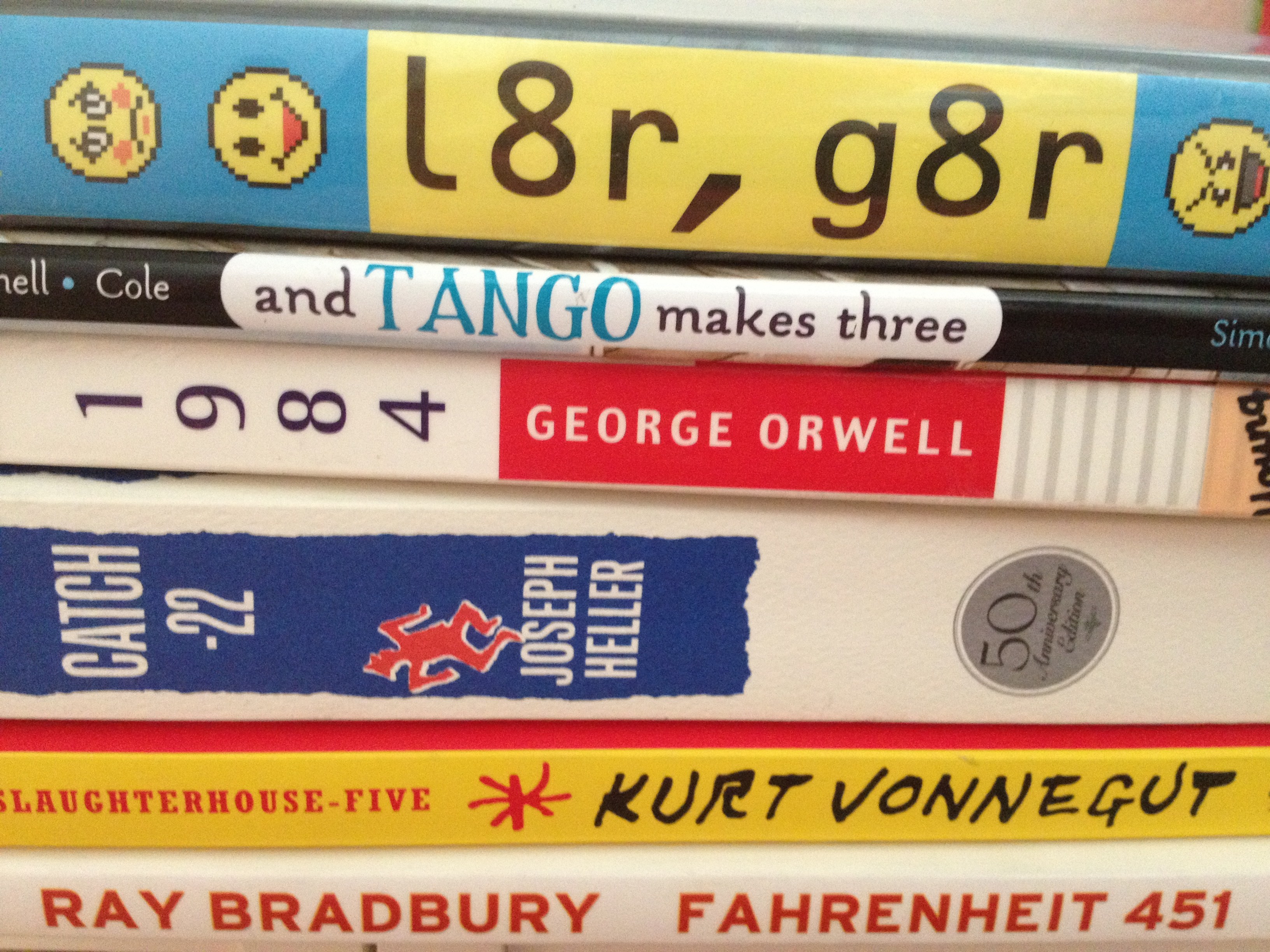
Hooray, I have cleared round 2! (Which is great bc I’ve already started reading into the Round 3 pile)

Photo Jun 23, 12 42 02 PM2

Rounds 1 & 2!

Round 1 (aka numbers)

Round 2 (aka famous/great books I have not yet read)

In researching censorship and book banning, I stumbled upon the Comic Book Legal Defense Fund, which is set up to protect the First Amendment rights of comic books and the community of artists, writers, publishers, sellers, and fans around it. They have this list of Banned & Challenged comics. Unlike the OIF lists, this is a list of case studies rather than a list ranked by frequency of challenges – but after reading a few classics in a row I’m happy for a little variety in my diet of controversy. So…

Photo Jul 01, 8 51 14 PM2

Round 3

Round 3 (20th century ennui & enter comics*)

  • All the King’s Men
  • One Flew Over the Cuckoo’s Nest
  • Fun Home
  • Ice Haven
  • Persepolis
  • Tropic of Cancer
  • The Dark Knight Strikes Again
  • Blankets
  • Stuck in the Middle

See you soon.

* I’d have made an “enter sandman” joke but having already read Neil Gaiman’s wonderful Sandman series, I’m going to opt to focus on new comics.

Banned Book Club: The Jungle

Title: The Jungle

Published: 1906

Author: Upton Sinclair

Challenge status:  #45 on  Radcliffe Publishing Course Top 100 Novels of the 20th Century and frequent target of banning attempts according to the ALA’s Office for Intellectual Freedom. Book #13 on Summer of Banned Books ’13.

Why: I think this is the first book I’ve read on the list that was banned/challenged due solely to the political philosophies espoused by the book, or attributed to the author. Specifically, Sinclair was a socialist.

  • Challenged interestingly, ALA doesn’t provide any info on US-based challenges.
  • Removed/Banned Yugoslavia (1929), East Germany (1956), and South Korea (1985).
  • Burned in the Nazi bonfires because of Sinclair’s socialist views (1933)

First line: “It was four o’clock when the ceremony was over and the carriages began to arrive”.

Synopsis: The book starts badly and each chapter that follows gets worse. Set in Chicago’s “Packingtown” at the turn of last century, the novel tells the tale of Jurgis Rudkus and his family, recent immigrants from Lithuania. The Rudkus family finds themselves trying to make a living in the shocking conditions of the profit-maximizing, corrupt, and disinterested meat-packing industry.

The book has the tonality of an investigative journalist who wants to communicate something big, brutal, and shocking to an audience that is surprised by nothing and thinks of facts as abstractions. In this way, the characters feel like simple devices to string one set of horrors to another. There is another interpretation, of course, that the character’s are never able to develop depth because their environment grinds them down and they are not able to survive, much less thrive.

Continue reading

Banned Book Club: To Kill a Mockingbird

Title: To Kill a Mockingbird

Published: 1960

Author: Harper Lee

Challenge status:  Winner of the Pulitzer prize and #4 on  Radcliffe Publishing Course Top 100 Novels of the 20th Century and frequent target of banning attempts according to the ALA’s Office for Intellectual Freedom. Book #12 on Summer of Banned Books ’13.

Why:

  • Challenged in many places (here’s the ALA list); reading through the list of complaints it looks like the primary issue is the racial epithet (i.e. the “n” word). I can’t help but laugh that the reason it was temporarily banned in 1977 in Eden Valley, MN was for use of the words “damn” and “whore lady”. (That’s all you got?) But then in upstate New York (VVS school district) the complaint was simply described as a “filthy, trashy novel”.
  • Removed/Banned seems to have been removed/banned a few times but then returned into the library/school/curriculum.

First line: “When he was nearly thirteen, my brother Jem got his arm badly broken at the elbow”.

Synopsis: I love this book! This whole “banned book club” experiment is totally worth it just on the joy of rediscovering this book. Initially, I was a little nervous about reading it directly after Native Son, also about racism and class issues. Native Son was really intense, and my memories of To Kill a Mockingbird were vague since I was probably 14 or 15 when I read it last — all I could remember was a courtroom scene and the dread of an inevitable but unfair verdict. And also something about a mysterious guy nobody knew but who got teased a lot. Well, there was that, but there was also a lot more.

Continue reading

Banned Book Club: Native Son

Title: Native Son

Published: 1940

Author: Richard Wright

Challenge status:  #27 on  Radcliffe Publishing Course Top 100 Novels of the 20th Century and frequent target of banning attempts according to the ALA’s Office for Intellectual Freedom. Book #11 on Summer of Banned Books ’13.

Why:

  • Challenged in Goffstown, NH (1978); Elmwood Park, NJ (1978), North Adams, MA (1981), — and high schools in Berrian Springs, MI (1988), High Point, NC (1996), and Fort Wayne, IN (1998) generally due to the book’s graphic violence, sex, and use of profanity
  • Removed/Banned from Irvington High School in Fremont, CA (1998) after a few parents complained the book was unnecessarily violent and sexually explicit.

First line: “Brrrrrrriiiiiiiiiiiiiiiiiiinng!”.

Synopsis: Native Son is the story of Bigger Thomas, a young black man living in Chicago’s South Side (the “Black Belt” in the 30’s, and the events that led to his execution. Wright is unflinching in his portrayal of Bigger’s life and character. We understand him but aren’t exactly rooting for him – his family is hungry but he doesn’t care enough to pick up a job, he toys with the idea of knocking over a local store, he bullies his friends in mean displays of temper – over-compensating for his own fears and lack of self-esteem. And yet, of course we hate to see Bigger stuck in the awkward social situation turned-tragedy, an accident that leads to the death of his new employer’s daughter. And we realize, as Bigger does, that the accident is really the end of Bigger, he is a dead man walking – anything he does afterward is not going to change the outcome of the situation. But it is still horrifying to see what Bigger does, as he transforms from – a young man who’s never bothered to think much about consequences (typical of all young men, whatever their educational, economic, or ethnic background) into a monster who desperately lashes out both at strangers and people who love him in his panic and desperation. Into the very monster that society-at-large expects him to be? Into a cipher, an animal, a generic representation of a feared outsider.

Continue reading

Banned Book Club: A Farewell to Arms

Title: A Farewell to Arms

Published: 1929

Author: Ernest Hemingway

Challenge status:  #20 on  Radcliffe Publishing Course Top 100 Novels of the 20th Century and frequent target of banning attempts according to the ALA’s Office for Intellectual Freedom. Book #10 on Summer of Banned Books ’13.

Why:

  • Challenged in NY (Vernon-Verona-Sherill School District) as a “sex novel.” (1980) and in Texas (Dallas Independent School District) (1974). Also challenged in 1987 at the Baptist College in Charleston, SC due to  “language and sexual references in the book.”
  • Banned in Italy (1929) apparently due to the description of the retreat from Caporetto. Also banned in Ireland (1939) and in Boston (1929).
  • Burned in Germany (1933)…by Nazis.

First line: “In the late summer of that year we lived in a house in a village that looked across the river and the plain to the mountains”.

Synopsis: Bite me, Hemingway.

No, seriously, I get it. Hemingway’s a total genius – who writes mind-numbingly boring books. Without looking-up literary crit, I’m guessing that Hemingway’s pioneering style is this flat, factual first person narrative that is literally observational with a minimum of messy internal dialogue. Hence his characters are always thus: A man of clear action! But of ambiguous character, morals, empathy, or capacity for growth. (Similar to descriptions of Hemingway himself, actually). Also: Why is this book described as romantic?

Continue reading

Banned Book Club: The Adventures of Captain Underpants

Title: The Adventures of Captain Underpants

Published: 1997

Author: Dav Pilkey

Challenge status:  #1 most frequently challenged book of 2012 according to the ALA’s Office for Intellectual Freedom. Also made the top 10 in 2005, 2004, and 2002.  Book #9 on Summer of Banned Books ’13.

Why:  Yes, why. How has a book about an underpants-clad character gotten so many knickers in a twist? Officially it was for “offensive language”, and the sort of catch-all “unsuited for age group”. So, first let’s talk about what constitutes a challenge, since what ALA tracks are challenges, i.e. attempts to ban: “A challenge is defined as a formal, written complaint, filed with a library or school requesting that materials be removed because of content or appropriateness. The number of challenges reflects only incidents reported. We estimate that for every reported challenge, four or five remain unreported. Therefore, we do not claim comprehensiveness in recording challenges.” What is not held is how many of the challenges were ultimately successful (i.e. resulting in a removal or ban).

Now, 2012 was something of a “medium” year when it comes to number of challenges reported — 464. The trend statistics are reported out to 2010 (1990-2010), but they show the top reasons for challenges are sexually explicit (3169), offensive language (2658), and unsuited to age group (2232). Parents were by far the largest group of challengers (6103), over 4x the challenges coming from the next largest category (patrons, 1450). And it also makes sense that schools and school libraries dominated the institutions that received the challenges — followed by public libraries. Keep in mind this is the ALA (American Library Association) that is tracking these figures.  Publishers are listed as a category, bookstores are not.

Regarding Captain Underpants, Slate magazine tries to explain why parents might hate the series so much, which basically comes down to the fact that the protagonists are disrespectful pranksters with no regard for authority, and that authority figures themselves are portrayed as buffoons. Ok, well I like Jessica Roake’s (author of the article) summary of the situation in support of the series: “the Captain serves as an excellent gateway drug to even more offensive-to-authority literature, which is actually the sinister goal of most English teachers. A place on the banned books lists puts Captain Underpants in some august company. Would Huck Finn be celebrated if he did what he was told? What if Holden Caulfield had just stayed at his nice prep school, or Ellison’s eponymous Invisible Man had accepted his lot in the South? Granted, Orwell is lacking in poop jokes (Shakespeare has some!), but Captain Underpants introduces its audience to a more relatable, elementary version of Orwell’s truth: A dirty joke is a sort of mental rebellion.” <- THIS

Continue reading

Banned Book Club: The Satanic Verses

Title: The Satanic Verses

Published: 1989

Author: Salman Rushdie

Challenge status:  #55 on  Radcliffe Publishing Course Top 100 Novels of the 20th Century and frequent target of banning attempts according to the ALA’s Office for Intellectual Freedom. Book #8 on Summer of Banned Books ’13.

Why:  In Pakistan five people died in riots against the book, which was banned in Pakistan (as well as many other countries including Saudi Arabia, Malaysia, South Africa, and India) due to its criticism of Islam. The book was also burned in England, and police requested the book be withdrawn from at least two bookstores due to threats made to staff and the stores. In Venezuela, owning or reading the book was declared an imprisonable crime, while in Japan sale of the book was banned (violators would be fined). Several people involved in selling, translating, or publishing the book were threatened or attacked (e.g. Igarashi – stabbed to death, Capriolo – wounded in an attack, Nygaard – shot and injured). Rushdie himself was subjected to a fatwa (issued by Ayatollah Khomeni of Iran), and lived in hiding/under police protection for several years. Now out of hiding, threats have continued to be made to Rushdie’s life as recently as 2012.

First line: “‘To be born again,’ sang Gibreel Farishta tumbling from the heavens, ‘first you have to die.'”

Synopsis: 547 pages of some of the densest prose ever. Ok, first let’s talk about reading experience. Part I, nearly the first 100 pages — unpleasant. In the sense that it is hard to figure out what’s going on and unclear what direction the whole tapestry is being woven towards. There is just some serious friction happening that keeps the reader working to get to the next page. However, towards the middle of the book the different storylines start to firm-up and things get a little easier to follow — there’s still a ton of characters, stories within stories, and parallel plotlines to keep straight — but at least it’s not such a mad jumble. And then things reconnect into one plotline through the finale.

Regarding the bannability. Ok, so, reading the book grabs onto characters across the divine spectrum, churning through them without making much distinction about which faith be being critiqued. What I mean by obvious is that the treatment of the divine happens at the most superficial level. A deeper point is that the fiercest competition between good and evil happens in the hearts and minds of individuals. Maybe that is the greater sacrilege, that a faith (or god, or pantheon of gods) can be bent in the service/interpretation/strategem of the faithful/faithless. It is not a pretty theme that good and evil are in the eye of the beholder, it is much easier to keep track of goodness and evilness if they simply adhere to absolutes.

Regarding the book itself; it is incredible. It is a symphony. The two main characters of the main plotline are two Indian actors (one famous in Bollywood (Gibreel), the other famous in London (Saladin)) who, in their miraculous survival of a plane hijacking/crash, literally re-enact a fall from grace with one character becoming a human embodiment of a demon (a satyr-like figure) and the other of the divine (Gabriel walking amongst us). The characters walk amongst us, first working through the trauma of their fall, then trying to reincorporate themselves in the world as though nothing happened, then following the directives of their “new” natures. In parallel there are a few other parables that replay some of the themes of the main plotline: faith vs truth, acceptance vs exclusion, abandonment vs connection.

Continue reading

Banned Book Club: The Great Gatsby

Title: The Great Gatsby

Published: 1925

Author: F. Scott Fitzgerald

Challenge status:  #1 on  Radcliffe Publishing Course Top 100 Novels of the 20th Century and frequent target of banning attempts according to the ALA’s Office for Intellectual Freedom. Book #7 on Summer of Banned Books ’13.

Why: Challenged at the Baptist College in Charleston, SC (1987) because of “language and sexual references in the book.”

First line: “In my younger and more vulnerable years my father gave me some advice that I’ve been turning over in my mind ever since”.

Synopsis: As far as challenges go, this book seems pretty tame – but since it’s #1 on the Radcliffe list AND apparently a frequent target of banning attempts, I figured I should finally read it. I somehow successfully avoided it through high-school. It is, naturally, well written and provides an interesting view a fairly romantic set of characters.  Of course the truth of romantic characters – today as in the roaring 20’s – is that they are all full-on “Monets”. Meaning, from afar you can see only beauty – but up close, what you see is a big ol’ hot mess. The book is also a vague coming of age journey for the protagonist Nick Carraway, who is mainly a passive observer through the story. Nick provides a “reasonable man” lens through which we can see the dramatic concluding events – though he couldn’t provide a moral compass to his fellow characters.

And of course the themes and messages are timeless. That fantasies, once built up in one’s mind, made even more elaborate over the years are curiously difficult to obtain in the flesh and will often disappoint. That some people will spend their lives driven by a fear-of-missing-out, and will end up missing out on all the things that matter. That money can’t buy you love – or if it can, someone else can probably outbid you for it. That fans are not friends and will disappear as your popularity fades. That people take what they have for granted until threatened by its absence, or find out what they have is desired by a rival. That some people have a sense of entitlement so deep that they literally don’t see people who cross their paths as anything more than stepping stones. That wealth and power are seductive, but can brutally isolating. That one’s character may be one’s destiny, but it’s what you do (behavior, not beliefs) that defines your legacy.

This book is a perpetual classic; always au courant in the portrayal of an elite social class that glitters but is ultimately hollow. I wonder if that’s the more subversive piece of the book; the language and references to adultery seem pretty PG compared to the graphic evisceration of the American dream.


Banned Book Club: Happy Bloomsday & some notes

Photo Jun 16, 8 26 34 AM

Round 1! And we’re just getting started.


For those of you following along thus far, you know I’m getting prepped for Banned Books Week 9/22-28. I’ve finished the first sprint (frequently challenged books with titles containing numbers!) and am taking a quick breath before diving into the next set of books. So far I’ve read & updated on:

I kind of like this mixing of classics with the newer books, though I feel more enriched drilling-down into great books than into what’s controversial today. (e.g. no, i will not be reading Twilight or 50 shades of grey). So I have the next grouping of books to announce, but first want to say Happy Bloomsday! And Happy Father’s Day!

And so today, in honor of Bloomsday (which commemorates the life of James Joyce and his novel Ulysses), I’m going to read: 1) The decision from US vs Ulysses/Random House (in which U.S. District Court Judge John Woolsey) lifts the ban on Ulysses, and 2) “Penelope”; the last episode of the novel, from the perspective of Molly Bloom.

Most of the books on my list have been challenged or banned from public libraries/schools. But Ulysses is a little different – it was actually prosecuted under obscenity laws in many countries; though written in English, resistance to the material was fierce enough that the book was first published in its entirety in Paris (1922) – and literally banned in the US & UK (there are records of the USPS burning copies) through the 20’s. In 1933 the ban was effectively lifted in the US when  Judge Woolsey ruled that the book was not pornographic and therefore could not be obscene.

James Joyce’s novel Ulysses was published in 1922, and follows the day of main character Leopold Bloom on June 16, 1904. (Joyce’s first date with his then-future wife Nora was on 6/16, and he set the date for his novel accordingly. ) The text, one of the most important works in Modernism, is extremely dense: rich in language, historical references, mythological allusions – and puns. To the reader the book is a chaotic blend of dreams criss-crossed with reality, but the tidal stream-of-consciousness prose does, somehow, reveal meaning. In 1998, the Modern Library ranked Ulysses first on its list of the 100 best English-language novels of the 20th century. I read Ulysses myself for the first time during a summer in college, when I was living in Philadelphia – home of the Rosenbach Museum (a book museum!) and one of the many places that celebrates Bloomsday annually.

After this excerpt from Ulysses, I’m going after these frequently challenged books next:

  • The Great Gatsby
  • The Satanic Verses
  • The Adventures of Captain Underpants
  • A Farewell to Arms
  • Native Son
  • To Kill A Mockingbird
  • The Jungle

Those of you who are very clever and know me well *might* think I’m procrastinating on something. Yes. I still need to upload my “Games We Play” notes, but actually I am procrastinating equally hard against my homework, also of the game theory variety.